Projects
Gruppo C.S.A. boasts many years of experience and extensive knowledge in environmental testing and analysis.
Gruppo C.S.A. has earned a reputation for handling complex, interdisciplinary projects with professionalism, expertise and innovation, making it a reliable partner for all of your needs.

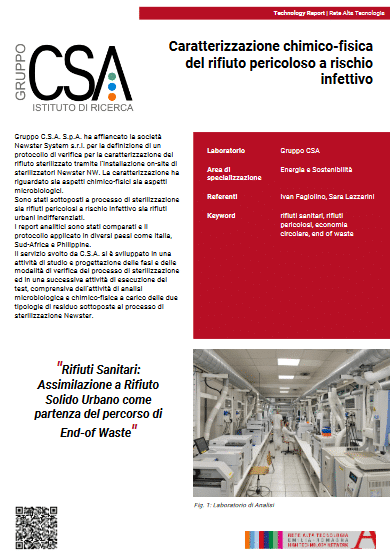
Physical and Chemical Characterisation of Potentially Infectious Hazardous Waste
Gruppo C.S.A has worked in close partnership with Newster System s.r.l. to develop a system to characterise waste that has been treated using Newster NW sterilisers (designed to be installed on site).
We evaluated the physical, chemical, and microbiological characteristics of both potentially infectious hazardous waste and urban waste that had been subjected to a sterilisation process.
Download for more details!⇒
Our Protocol
- Weekly analysis of the amount of unsorted urban waste and potentially infectious hazardous waste;
- Reporting and comparative analysis;
- Sampling of 7 kg of potentially infectious waste, 1 kg per day (SAMPLE A);
- Daily sterilisation of urban waste and sampling of 1 kg for 7 days, for a total of 7 kg (SAMPLE B);
- Preparation of a mixed sample of sterilised medical waste and unsorted urban waste, mixed in the ratio 1:3.5 (SAMPLE C);
- Analysis of all three samples; comparative analysis using Sample B as benchmark.
Innovative Aspects and Results
Monitoring was performed at “Sol et Salus”, an Accredited Private Hospital in Rimini, and at “Gruppo Multimedica”, a Scientific Institute for Research, Hospitalisation and Healthcare (IRCCS) in Milan.
We also tested waste samples from Karl Bremer Hospital, Cape Town, South Africa, and Rizal Medical Center, Barangay Bagong Ilog, Pasig City, Philippines.
The results proved that Newster sterilisers meet the STAATT level 4 (6log10) international criteria for the sterilisation of medical waste.
We found that both types had the same chemical-physical characteristics and exhibited no hazardous characteristics in compliance with recent regulations.
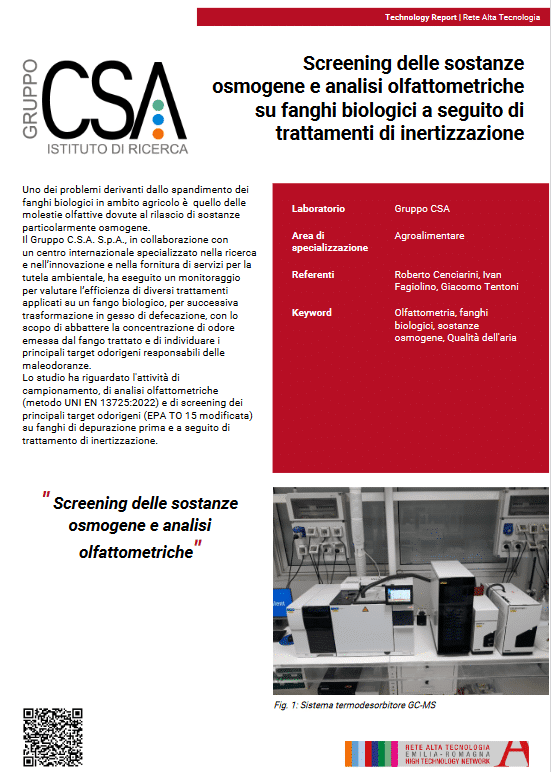
Analysis of Odoriferous Substances and Secondary Sludge
Gruppo C.S.A. has partnered up with a renowned international centre specialising in research and innovation and environmental protection services.
Together, they monitored and evaluated the efficiency of the treatments performed on secondary sludge and defecation gypsum to minimise odour emissions and identify the main components responsible for bad odours.
Download for more details!⇒
Our Protocol
- Sampling and analysis of sewage sludge: the air emitted from the material assessed is sampled to identify the main components responsible for odours, as well as for olfactometry analysis.
- Sampling and analysis of treated sewage sludge: the secondary sludge samples undergo 6 different treatments to be transformed into defecation gypsum. They are then delivered to Gruppo C.S.A. S.p.A.’s lab for air sampling and olfactometry analysis, as well as to identify the main components responsible for odours.
- Comparing results: the data obtained from the defecation gypsum and sewage sludge samples are analysed and compared.
Innovative Aspects and Results
Olfactometry analysis is key to detecting and assessing low levels of odoriferous compounds and determining how to best minimise odour emissions.
We also test odoriferous compounds (also with low odour detection thresholds) for a number of different features and characteristics, including concentration, character, and chemical analysis.
These two techniques allow us to identify sources of odour emissions and determine which odour control measures to apply based on the specific compound.
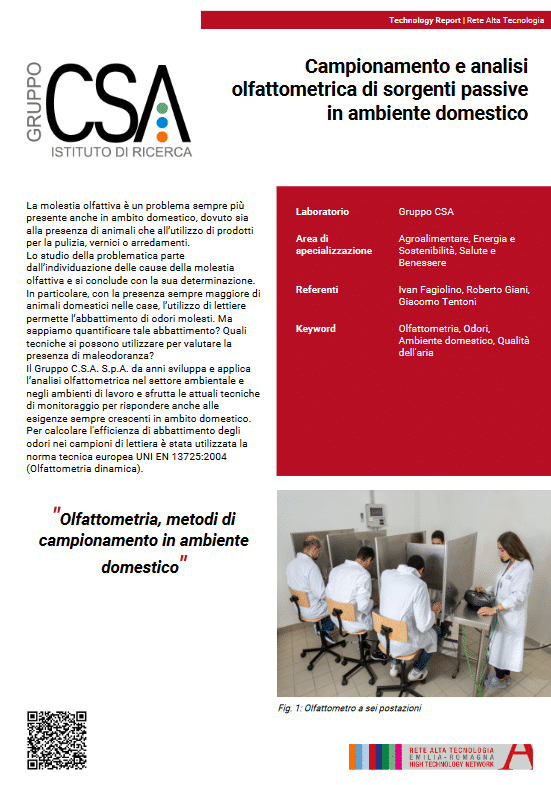
Sampling and Olfactometry Analysis of Passive Odour Sources
Gruppo C.S.A. conducts odour monitoring and odour assessments to help reduce or remove the odour from pets, cleaning products, paint, and furniture.
We collect litter samples and assess their odour control properties in accordance with UNI EN 13725:2004.
Download for more details! ⇒
Our Protocol
Our odour consultants determine the odour concentration of an air sample taken from a point or surface source using dynamic olfactometry, in compliance with the relevant regulations.
The odour analysis of litter is performed using a low-speed wind tunnel.
Then, we use a six-station automated olfactometer to identify:
- the flow rate and concentration of odour in an empty litter box containing an ammonia solution;
- the flow rate and concentration of odour in clean litter;
- the flow rate and concentration of odour in litter after adding synthetic cat urine.
Innovative Elements and Results
Compared with other evaluation tools, olfactometry analysis is able to detect and assess odoriferous compounds even when they are present at a very low concentration.
This technique, in the case study at hand, allows us to determine with good accuracy the odour removal capacity of adsorbent materials (litter).
In previous studies, the same evaluation, performed by analysing the adsorption of ammonia on silica gel, did not yield satisfactory results.
Contact our lab for more information
Please fill in the following form with your enquiry